Conspirators surround us. Conspiracists are not.

A few hours after the attempt on the president's life last weekend, the "false flag" accusations hoisted hastily on social media were flying half-mast. Just a few hours later, they'd been struck. Lone gunman. Senseless. Sure.
Calmer heads prevailed. That’s what calmer heads do.
This week, the calm heads will also prevail over Alex Jones. InfoWars, which Jones was forced to sell after a $1.5B defamation judgment for the Sandy Hook parents he smeared as "crisis actors,” is becoming the property of The Onion. Though the prior instantiation of InfoWars will not be missed by many outside the supplements business, it’s not clear that a win against conspiracy theorists is an unmitigated victory for the forces of reason.
Even though conspiracy – sometimes malicious, sometimes magnanimous – is core to the work of the marketers, lawyers, doctors, journalists, political operatives, and financial analysts who constitute the professional managerial class, we dismiss conspiratorial thinking as low-status behavior. Conspiracism suggests, after all, a lack of institutional access. A lack of connections. Dismissing conspiracies is not, as we might wish to believe, simply a way to repudiate malignancies like Alex Jones, but a way to perform proximity to power. That performance, ironically, provides air cover for conspirators, often including ourselves.
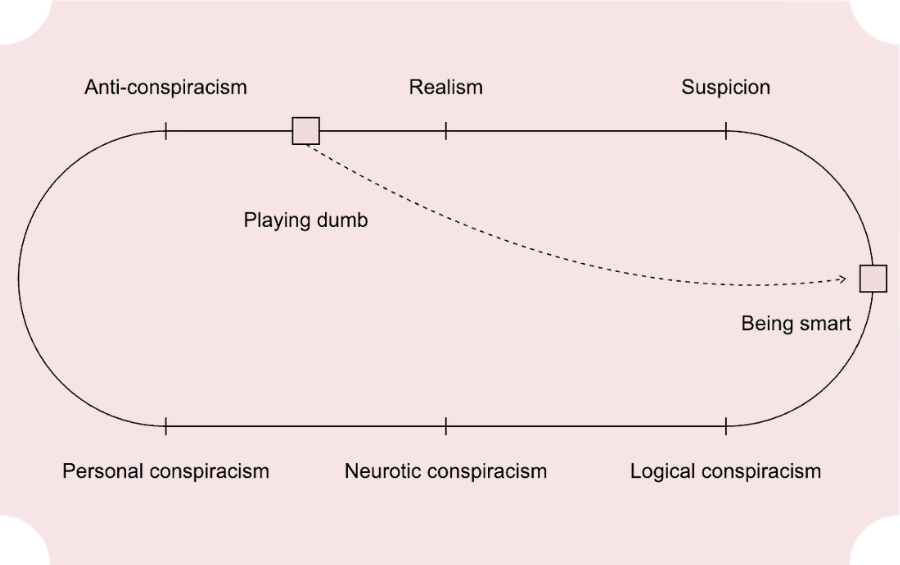
If there's a spectrum of thinking that runs from anti-conspiracism, the belief no one is conspiring, to personal conspiracism, the belief the conspiracy is about you, most members of the Oat Milk Elite fall toward an extreme at odds with our education. We know the FBI ran COINTELPRO against civil rights leaders and that the CIA dosed Americans with LSD and that Kissinger treasonously parlayed with the South Vietnamese in 1968 to help Nixon win. We know tobacco companies hid carcinogenicity and Exxon hid climate change. We know these are not conspiracy theories, but conspiracy facts – and only the ones that came to light. It's only reasonable to assume others didn't.
For years, InfoWars operated on the principle that most didn’t. In and of itself, that's a good principle for a media outlet. The reason Jones was hated and ostracized was that he was wrong. Almost constantly. But he was often wrong about the right things. Jones got to the Epstein story early. He was among the first to cover the unminuted Bilderberg meetings. He was on NSA bulk collection a decade before Snowden.
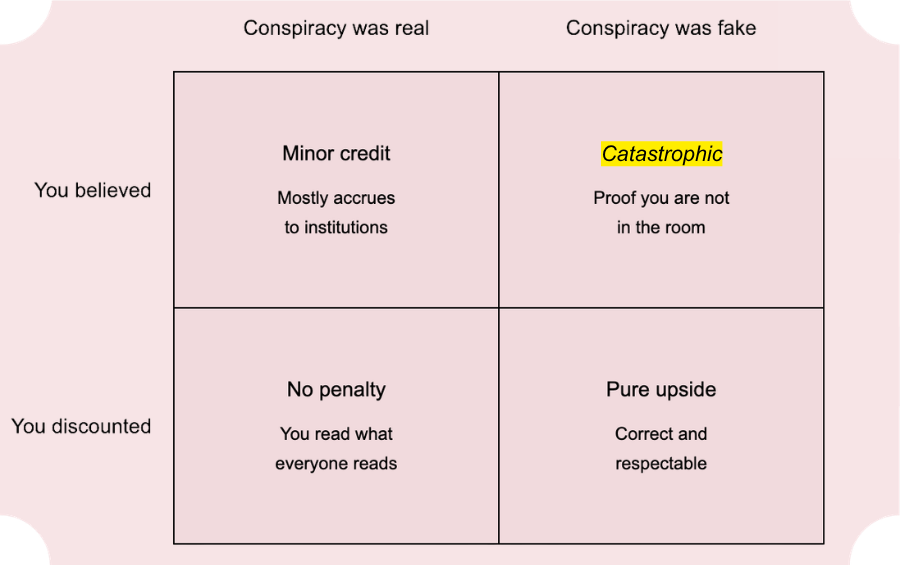
But the reward system for public conspiracism is asymmetrical among the educated elite. There's minimal upside to being right and almost unlimited downside to being wrong [2].
That asymmetry occurs because publicly voicing a conspiracy theory almost always requires also voicing stigmatized knowledge. Doctors lie to their patients [3]. Regulators optimize for future job offers. Consulting is mostly executive air cover. HR is a Trojan Horse [4]. College admissions are rigged. Expert testimony in civil litigation is purchased. This is why calm heads in the press (who trade quotes for coverage) recast the conspiracies they uncover as scandals. Doing so implicitly argues that someone failed the system even when the system worked as designed. Times columnists have friends at the Council on Foreign Relations, Goldman, McKinsey, Brookings, and Sullivan & Cromwell.
Professional class obligation requires obfuscatory obtuseness.
Seen from that angle, reflexive anti-conspiracism is our coherent response to having the game rigged in our favor. By aggressively ostracizing conspiracy theorists, we cover for friends who spend at least part of their day doing the rigging and pathologize those who have the unmitigated gall to treat us with just a hint of suspicion.
And anti-conspiratorialism can become extreme. In 2008, Cass Sunstein, soon to run Obama's regulatory office, published a paper recommending covert federal infiltration of citizen belief networks to disrupt conspiracy theories. The paper literally described a conspiracy to disrupt conspiracy theories. Obama, the apotheosis of the professional managerial class's meritocratic ideal, hired him.
Did Cole Allen act alone? Probably. Did the Secret Service let him on the President’s orders? Probably not. Did the President give a post-shooting press coverage about the need for a White House ballroom because he wants to expand the military bunker under it? Probably. Was Alex Jones wrong about everything? Yes. And no. And we’ll probably never find out. That’s not the kind of work The Onion does.
Calm heads do not get to the bottom of things. They just prevail.
Dinner Party AlphaHBS is an influencer hub.➼He's not upset. He's insecure.
|