Issue No. 75  ·  April 21, 2026
Upper Middle Logo

Pain au chocolat is both an order and an emotion.

Your biggest investment is the gov't. How you feelin' about that?
In this issue
01 Mathemagical Chairs ➼ Gamifying the dinner party seating chart.
02 Cinnabar Flies ➼ The devil and the deep cerulean sea.
03 Making Partners ➼ Emergent trad-ness among high-income couples
Upper Middle Illustration
 
Note If you haven’t taken our Taxes & Democracy Survey yet or messed around in Upper Middle Analytics, please do. Results soon!
 
Also Taste Tests·Upper Middle Analytics·Class-ifieds
Status

Mathemagical Chairs
How to solve the inevitable seating problem when you (finally) have your first spring get-together.
Upper Middle Divider

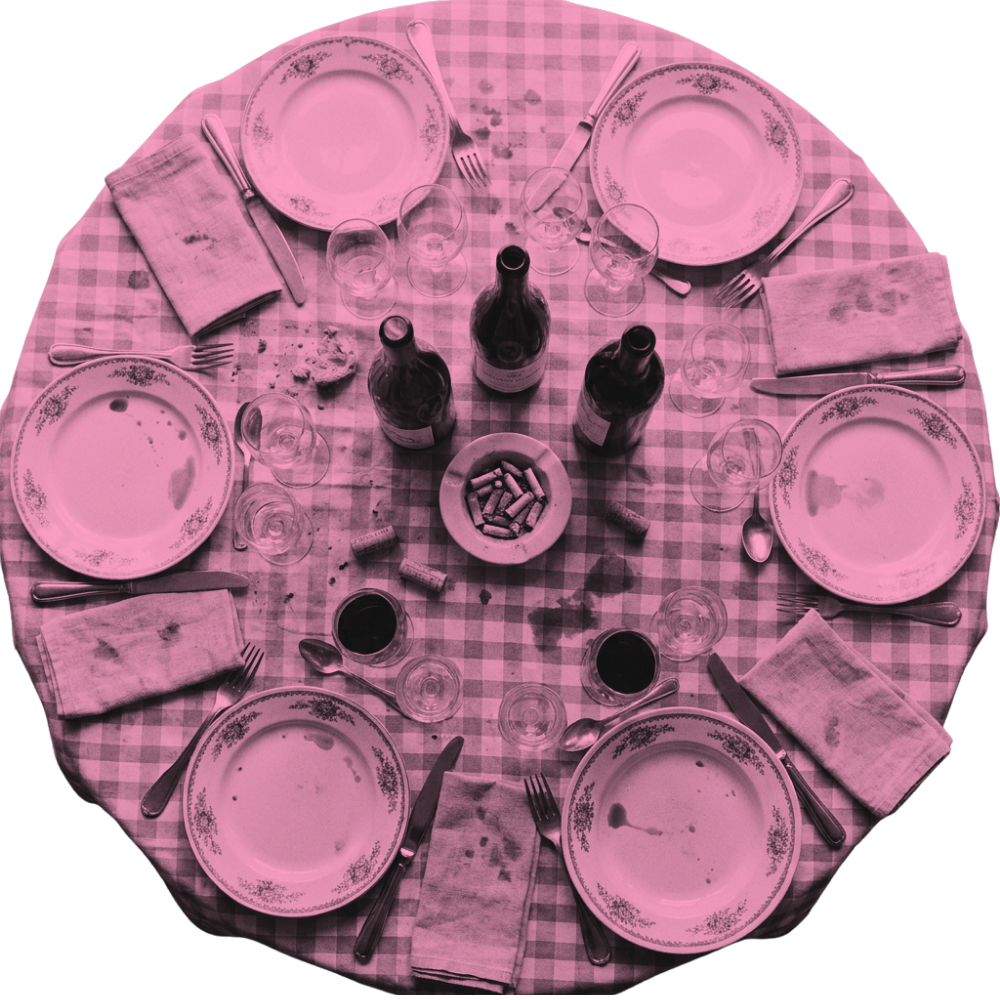
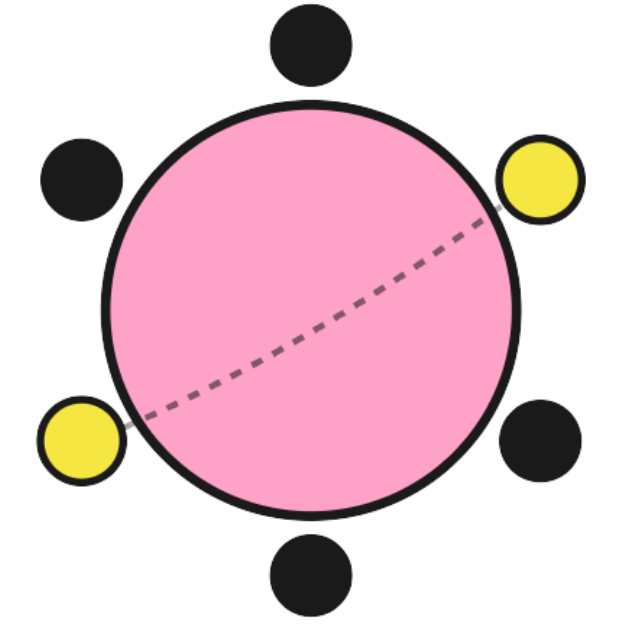
There are three possible ways for two couples to arrange themselves around a table, 60 ways for three couples to sit, and 2,520 ways for four couples to make themselves comfortable. The likelihood that guests at a scaled-up sit-down will settle on an envy-free arrangement — one in which no one wants to switch with someone else — is negligible. The odds a host will triangulate a similarly accommodating geometry are similarly low if that host thinks in terms of Ben enjoys talking to Sarah about Pickleball. But there's a workaround. Three (presumably fondue-addled) Swiss computer scientists found it [1].

Don't think about Ben or Sarah, or, heaven forfend, Pickleball. Think about archetypes. Seating arrangements become a far more tractable mathematical problem when hosts stop modeling guests as individuals and start by sorting them into archetypes with consistent preferences. Because consistent preferences limit the number of possible arrangements, the asymptotic explosion of seating options never occurs. Relatively few arrangements make sense. And the only social math required is classifying the guests – something we all do anyway.

The Place Card Game
The Place Card Game
Try to seat a table the Swiss way. Life gets easier once you figure it out.
Play
Upper Middle Illustration
Upper Middle Analytics
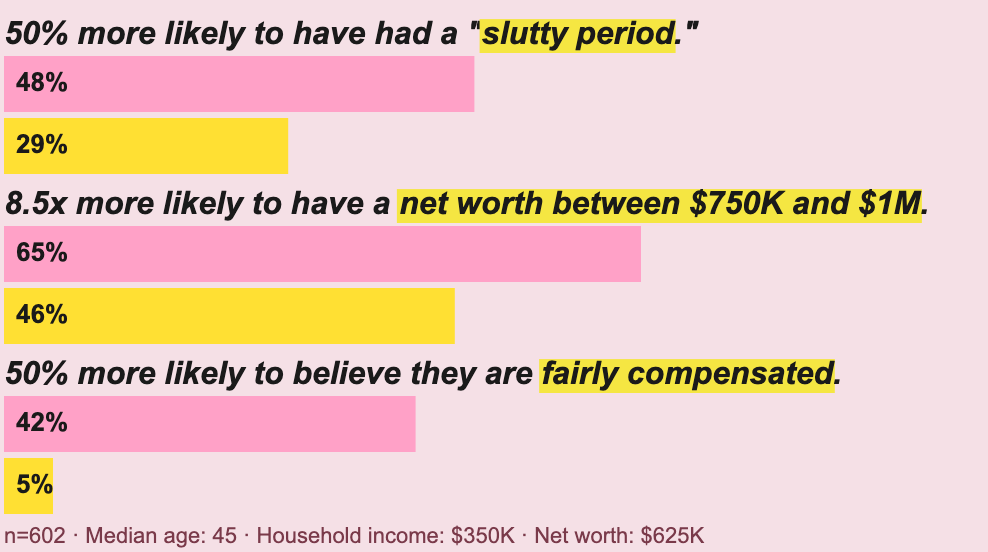
Elites Who Joke About Their Mental Health Are...
Upper Middle Analytics chart
Taxes & Democracy
Taxes & Democracy

You get what you pay for... except when you don't.

Take Our New Survey →
 
You already compare yourself to your peers. Now, do it with data. Surveys take 1-2 Min. Personalized results generate in 5-10 seconds.
Nepotism & Family Capital (n=1161)
COMPARE →
Self-Presentation & Self-Misrepresentation (n=602)
COMPARE →
Sex & Attraction (n=408)
COMPARE →
Upper Middle Illustration
Taste

Cinnabar Flies
The flacks pushing Devil Wears Prada 2 didn’t really get the first one.
Upper Middle Divider

If anyone in Disney's promotion department had even an ounce of reverence, the red carpet (cinnabar, really) at the DWP2's Lincoln Center premiere would have been cerulean, the color Miranda Priestly memorably explains to her be-spectacled, be-sweatered, be-fuddled assistant in the original was “selected for you by the people in this room.” But if the first film argued that taste is essential cultural work, the rollout of the second has implicitly argued… nah [2]. The social media embargo lifted last night, giving all the influencers, TikTok girlies, and micro-celebs that minced out of David Geffen Hall post-screening a 36-hour head start on the critics, who won't enter the discourse until midnight tomorrow — presumably after weekend ticket sales pop.

But there's always a room and there are always people in it. The question the second film seems to pose is whether or not we're better off if Miranda is one of them. Yes, she's an above-it-all bitch. But being above it all is her job – the whole point of the Priestly caste. The influencers in the tent last night were trading distribution for relevance. The whole point of Miranda and critics like her is that they do not trade; they represent the interests of consumers (colored, ofc, by their own preferences) with deep integrity. Without a Miranda in the room, no one has that job. Only the marketers are left. They pick fucking cinnabar.

Upper Middle Illustration
Taste Tests
Women's Leggings

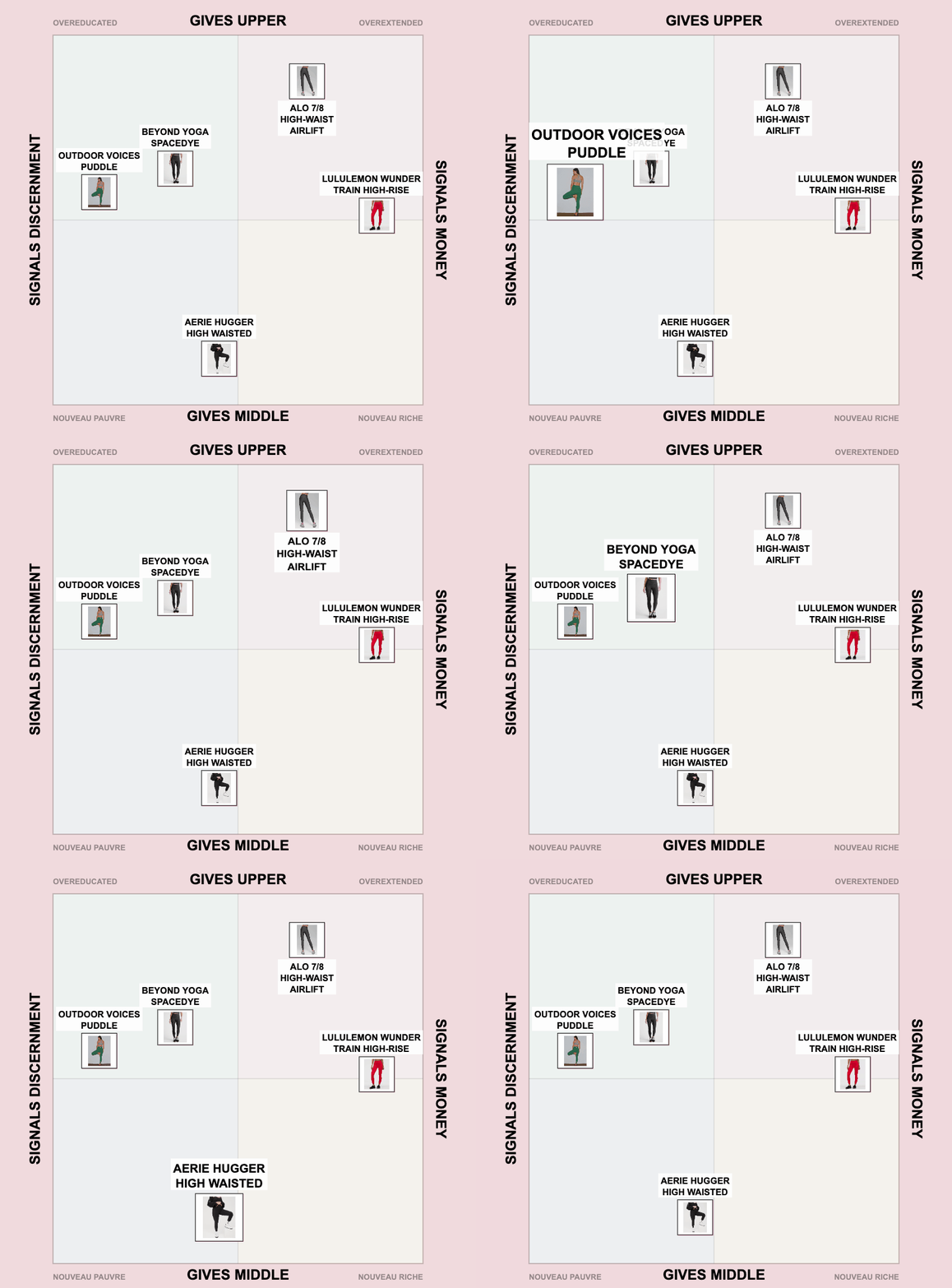
If you've ever taken a yoga or pilates class, you know you can tell a lot about a woman from her tightest pair of pants.

Taste Test Maps Women's Leggings
Can you pronounce savasana? Take the test →
Ranked by perceived discernment
Outdoor Voices Puddle Legging$88
Beyond Yoga Women's Spacedye Caught in The Midi$97
Athleta Interval Stash High Rise 7/8 Legging$81.75
Aerie Hugger High Waisted Legging
SPANXshap Booty Boost Leggings
7/8 High-Waist Airlift Legging$134
Lululemon Wunder Train High-Rise Tight$98
Dog Breeds
NEW TASTE TEST
Dog Breeds
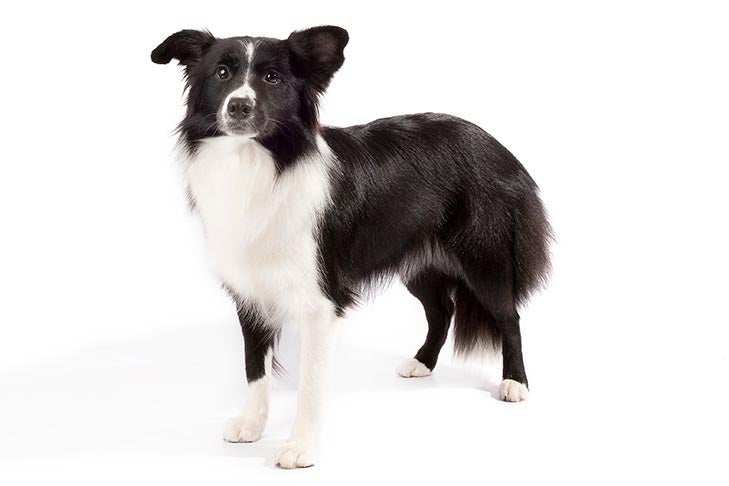
What do your snap judgments say about you? Find out if you're good at being judge-y by comparing your first impressions to others.
TAKE THE TEST →
Upper Middle Illustration
Money

Making Partners
Why trad-ness is an emergent property of high-income partnerships.

Upper Middle Divider

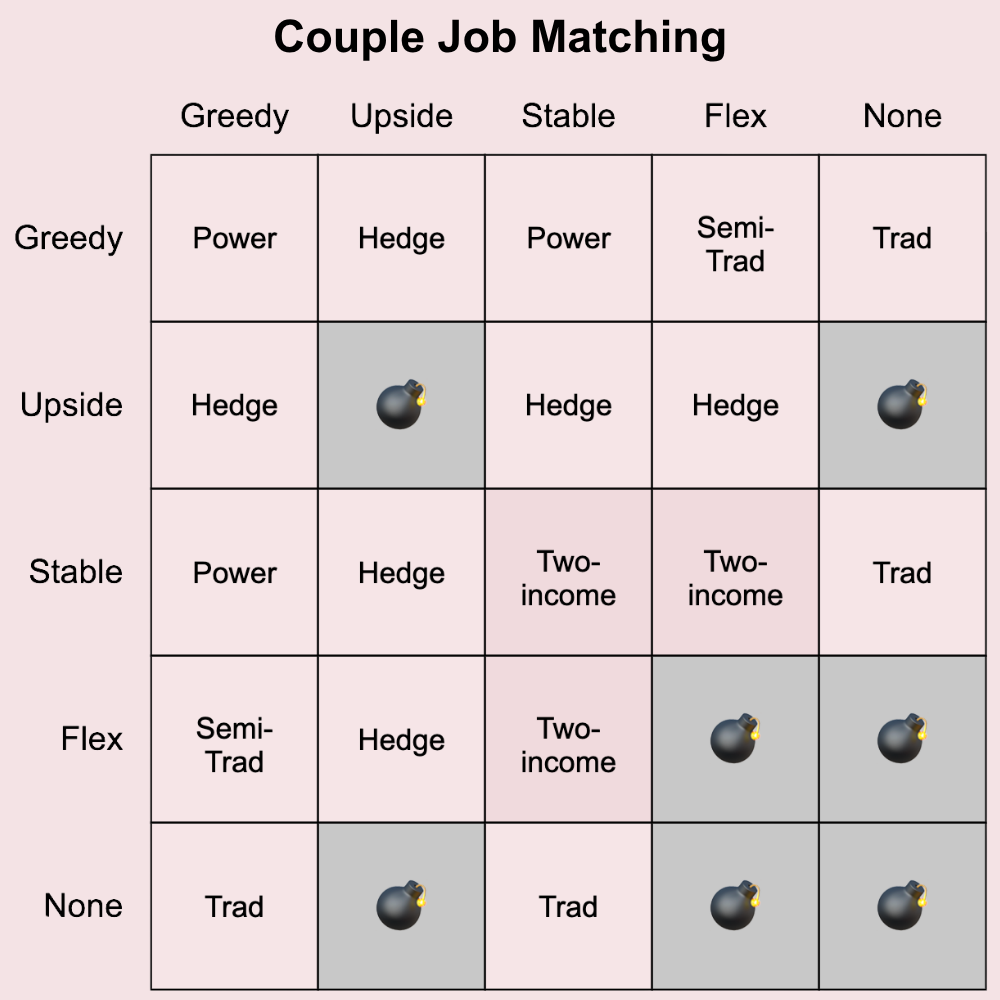
The whole "trad wife" thing isn't really about tradition. It's about socio-economics. The Stanford sociologist Alexandra Killewald demonstrated in a 2020 study that between 1989 and 2016, only couples in the top income decile became more likely to adopt a single-earner arrangement. Everyone else went the other way.

The reason is relatively simple:. Most rich couples get that way because at least one partner has a "greedy job" — a job with pay that increases faster than work hours, disproportionately rewarding the always-on worker. Hours goes up 50%. Earnings go up 100%. Variations on that. The phenomenon is common enough that Claudia Goldin won a Nobel in 2023 for describing it in her book Career and Family. It's why trad-ness works for those it works for and annoys the hell out of everyone else [3].

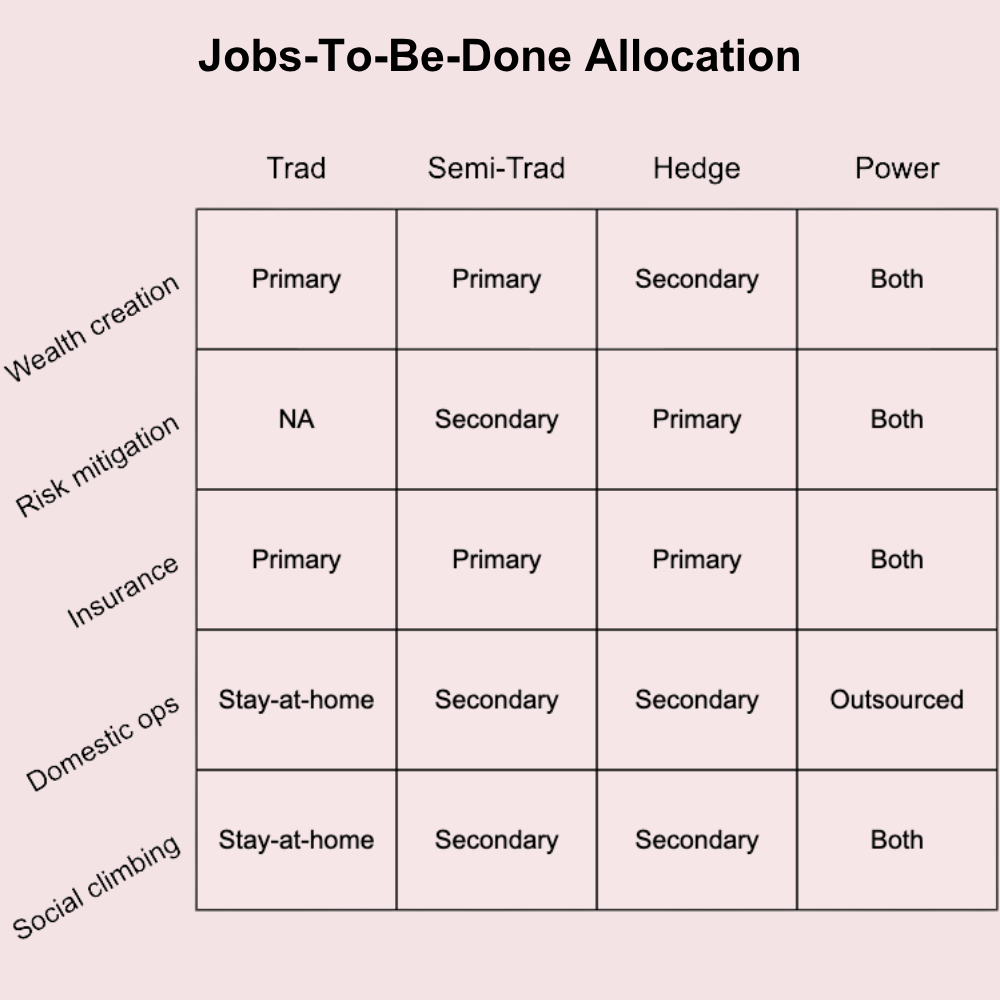
The majority of upper-middle class couples fall under the umbrella of everyone else. They lack a single earner capable of underwriting both the trad pivot and Montessori school, or they don't include a partner ready to stay home. So most couples — specifically most couples with children and couples in their mid-to-late thirties — start to reconsider how they think about jobs. Instead of thinking about their two jobs, they start thinking about the plus-or-minus five jobs-to-be-done that go with having a vaguely affluent family: wealth creation, risk mitigation, insurance, domestic operations, and social climbing. These are the things a couple has to accomplish collectively — the requirements that push two-income households not ready to go full trad toward three very specific configurations: the Power Couple (two careers, one network, overlapping constraints), the Hedge Couple (two careers, one chasing stability, the other chasing upside), and the Semi-Trad Couple (one dominant earner, one flexible partner).
image

Because only one partner can be always-on, the primary job-to-be-done — wealth creation — is most easily done by one partner at a time. Trad and Semi-Trad couples organize around this explicitly. So do Hedge Couples, in which one partner is given multiple opportunities to take risks with significant upside (amplified by tax law) [4]. A 2021 analysis of Canadian tax records found that married households are measurably more risk-on than singles because a steady second income makes failure manageable. Power Couples don't initially organize around one partner's earning potential, but almost inevitably do, because the lower-earning partner's professional bandwidth is eventually best deployed supporting their spouse. They can bill at the higher rate.

It is also critical to mitigate risk. Two-income households that require both incomes to operate in the black double their exposure to economic shocks — either partner getting sick or laid off destabilizes the whole project. Hedge and Semi-Trad couples are fine on one salary. Power Couples can reorganize quickly as superpowered individuals. Elizabeth Warren didn't name it the "two-income trap" for nothing.

As for insurance, it matters more than anyone admits. In 1996, economists showed that access to a spouse's health insurance is one of the strongest predictors of self-employment entry in America. The founder's courage, the artist's creativity, and the cook's commitment to farm-to-table sourcing are often bolstered by access to a partner's Aetna plan. The archetypal Silicon Valley marriage — founder plus physician, founder plus teacher, founder plus in-house counsel — is a Hedge Couple until the liquidity event, then a Trad Couple (then a single guy undergoing testosterone replacement therapy).

Arguably the hardest of the jobs-to-be-done is domestic ops. Being on top of all that stuff is more than a partner with a greedy job can handle, which is why Semi-Trad Couples remain common and why Hedge Couples place such a premium on flexible schedules. It's also why couples in which both partners have somewhat greedy jobs that don't pay fuck-you money wind up in therapy wondering why the other one doesn't do enough.

It's not that the other doesn't do enough. It's that the other doesn't do the other jobs-to-be-done.
image


Of course, what makes a couple upper-middle class isn't just what they make; it's what they spend. And spending well turns out to be surprisingly tricky. Getting into the right school, the right dinner parties, and the right ass-sculpting leggings all takes time. Status-seeking is the greediest of the jobs-to-be-done. American couples in which the wife earns more than the husband are roughly 50% more likely to divorce than those in which the husband earns more. There are plenty of reasons for this and male insecurity is most of them, but another is that social networks tend to be female-dominated so men often fail at climbing. They can't get the job done.

Interestingly, very little of this comes down to choice. Careers are emergent properties of partnerships. And that's not a bad thing — it's a privilege to get to work together, arguably the most profound measure of devotion among the godless and overeducated. But it creates a peculiar dynamic. Couples who don't go in for that trad stuff get dragged trad-ward regardless.

Maybe that's okay.

Upper Middle Illustration

Class-ifieds

Reader listings — jobs, referrals, housing, and everything else

Three Novels, Zero Agents

Prolific literary fiction writer seeks masochistic beta readers willing to wade through domestic upper-middle malaise — think Updike with better snacks. Three manuscripts completed last year; query responses suggest the publishing industry is fine, thanks. Will reciprocate with sharp editorial feedback on your creative work or, for Massachusetts locals, genuinely excellent cookies. Casting for the biopic is flexible.

Reply →

Country Mouse Seeks Focus Group

Avid indoor enthusiast developing housing in a small, quaint New England city seeks candid opinions from city mice about what they are looking for when they daydream about relocating. Price? Square footage? Parking? Aesthetics? Not a survey. More of a vibe check with zoning implications. Full disclosure, the country mouse will make you look at Pinterest boards. Could be fun.

Reply →

How can we help you?

Place an Ad →
Upper Middle Illustration
Andrew Burmon Footnotes

[1] Berriaud, Constantinescu, and Wattenhofer's 2023 paper won best paper at the Web and Internet Economics conference, which – if you think about it – is almost better than having had sex in high school. [2] I’d argues TDWP is a movie about a person who is unwilling to do what it takes and probably better off for it. It’s basically Devil’s Advocate with more shoes. [3] Also, the misogyny. [4] This is me and I think people aren’t honest about entrepreneurship. It’s often about reps and getting reps requires extraordinary conviction or, alternatively, someone else buying groceries.